
Last Updated on July 23, 2026
ABS due diligence is the structured review of the assets, documents, and structure behind an asset-backed securities transaction, carried out so investors and rating agencies can gauge the deal’s risk before it prices.
It plays out as a multi-stage workflow, moving from data preparation through asset review, investor and rating-agency review, verification, and finally disclosure. The work pulls in the issuer, the underwriters, third-party review firms, and individual reviewers, and it is usually coordinated inside a single secure data room.
Key takeaways
- ABS due diligence examines the underlying assets at the individual loan level, not just pool-level averages.
- The core review streams are credit, collateral, regulatory compliance, servicing, and data integrity.
- Third-party review (TPR) firms frequently perform the asset review, often on a statistical sample of the pool.
- Issuers and underwriters must publicly disclose the findings and conclusions of any third-party due diligence report.
- A secure data room ties the workflow together with scoped access, structured Q&A, and a complete audit trail.
What is ABS due diligence?
ABS due diligence is the process of inspecting the loans or receivables that back an asset-backed security, along with the deal’s documents and structure, in order to confirm the assets are what they are represented to be and to put a number on their risk.
It is the moment when investors and rating agencies test the issuer’s representations before they commit capital or assign a rating.
What sets it apart from corporate M&A diligence is how granular it gets. Reviewers don’t stop at summary statistics; they work through the underlying assets, increasingly loan by loan, because pool-level averages can mask risk layering inside the pool. That granularity is exactly why securitization diligence is so document- and data-heavy.
Who is involved in ABS due diligence?
ABS due diligence brings together several parties, each with a distinct role and a different level of access to the deal materials. Knowing who needs what is the starting point for a well-run workflow.
- Issuer / sponsor: assembles the pool, prepares the data and documents, and stands behind the representations and warranties.
- Underwriters: structure and market the deal, and share responsibility for diligence and disclosure.
- Third-party review (TPR) firms: independent firms engaged to review the pool assets and report their findings.
- Rating agencies (NRSROs): assess credit risk and assign ratings, relying in part on diligence results.
- Investors: work through the materials to reach their own credit and value judgments.
- Trustees, servicers, and counsel: administer, service, and document the transaction.
Because these parties are often working in the deal at the same time, access has to be scoped precisely to each role.
What are the stages of an ABS due diligence workflow?
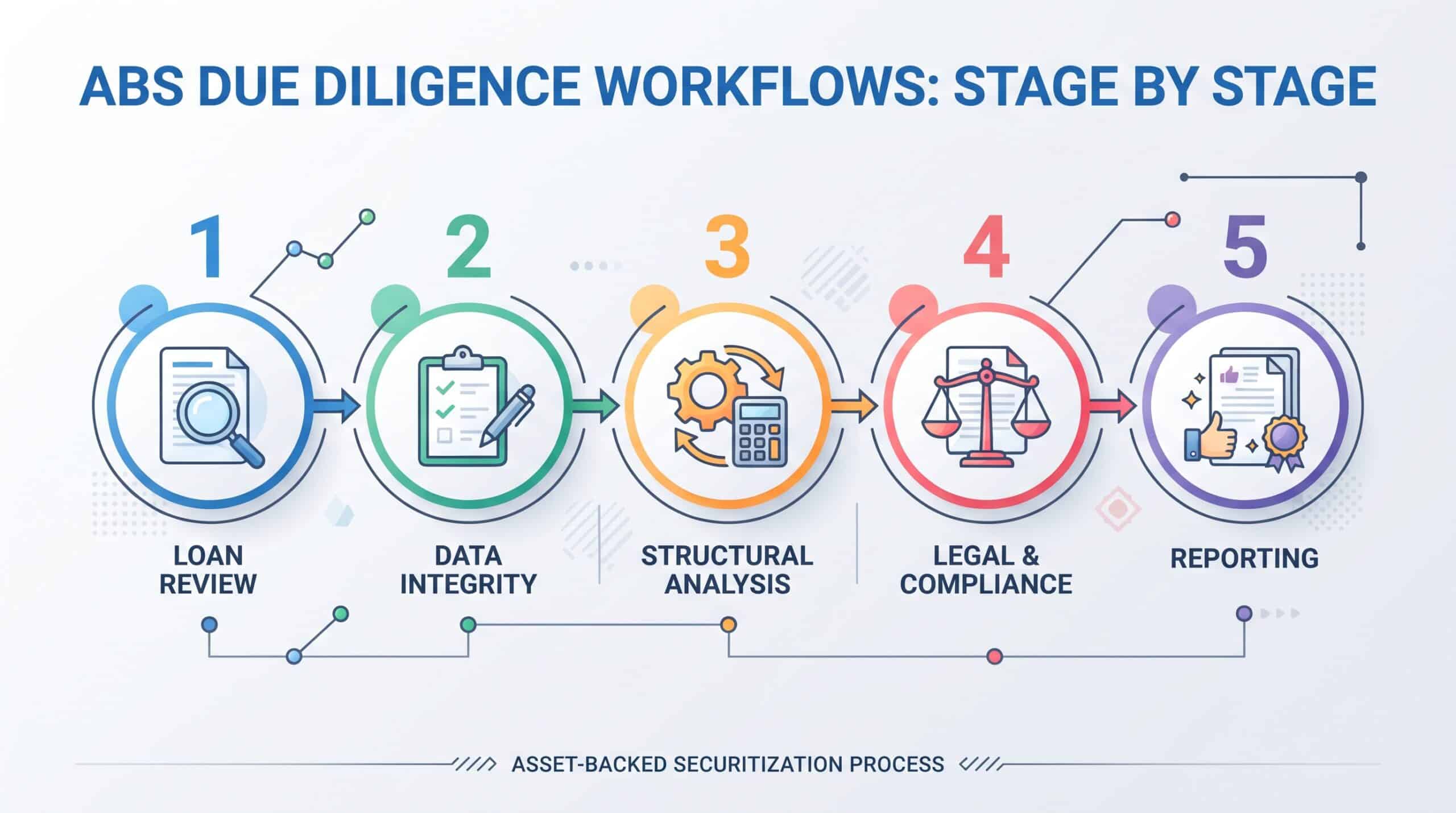
An ABS due diligence workflow runs through five stages, from preparing the data to disclosing results and closing.
- Data preparation. The issuer or arranger gathers and uploads pool-level and loan-level data, organizes the document repository, and sets access permissions.
- Asset review. A third-party review firm (or the reviewing parties directly) examines the assets, typically a statistical sample of the pool, across credit, collateral, compliance, and data-integrity dimensions.
- Investor and rating-agency review. Investors along with hired and non-hired rating agencies open the scoped materials and run their own analysis.
- Q&A and verification. Structured Q&A routes questions to the right responders and preserves a record, while reviewers verify data against source documents.
- Disclosure and closing. The findings and conclusions of any third-party due diligence report are disclosed, final documents are executed, and the full activity record is retained.
What gets reviewed in ABS due diligence?
ABS due diligence works across several streams, credit, collateral, regulatory compliance, servicing, and data integrity, to build a complete picture of pool quality. The table below summarizes what each stream looks at.
| Review stream | What it examines |
| Credit | Borrower creditworthiness; income, asset, and employment documentation |
| Collateral / valuation | Appraisal accuracy and the value of collateral securing the assets |
| Regulatory compliance | Conformity to federal, state, and local statutes (e.g., disclosure rules) |
| Underwriting conformity | Whether origination followed stated underwriting guidelines and criteria |
| Data integrity | Whether data provided about the assets is accurate and matches source files |
| Servicing | Servicer practices and collateral performance |
Reviews can cover a statistical sample of the pool or, for some transactions, the complete pool. The deeper and cleaner the underlying data, the faster and more reliable this review becomes.
How does third-party due diligence and disclosure work?
Third-party due diligence works by having an independent review firm examine the pool assets and report what it finds, which the issuer or underwriter then has to disclose.
Under post-financial-crisis rules from the Dodd-Frank Act, ABS issuers and underwriters, in both registered and unregistered transactions, must publicly disclose the findings and conclusions of any third-party due diligence report obtained on the pool assets.
That disclosure has to be detailed enough to explain the review: the type of assets reviewed, the sample size and how it was determined, whether the accuracy of the asset data was checked, whether origination conformed to underwriting guidelines, whether collateral value was reviewed, and whether the originator’s regulatory compliance was reviewed.
Separately, for shelf-registered ABS, an Asset Representations Reviewer (ARR) can be triggered to review assets for representation-and-warranty compliance if a delinquency threshold is breached and investors vote to conduct a review.
Operationally, the review firm’s findings, the underlying data, and the disclosure records all live in the deal’s data room, with controlled access and a complete audit trail.
How does a data room support the ABS due diligence workflow?
A data room supports the ABS due diligence workflow by giving every party scoped access to the right materials, organizing huge datasets for review, and recording every action for disclosure and audit. It turns a multi-party, document-heavy process into a coordinated one, rather than a scramble across email and shared drives.
The capabilities that matter most are bulk ingestion and automated indexing of loan-level data, OCR-powered search so reviewers can locate specific records quickly, document-level role-based permissions so each party sees only its scope, structured Q&A to manage investor and reviewer questions, and a complete, exportable audit trail.
ABS due diligence checklist
Use this checklist to run a complete ABS due diligence workflow:
- Prepare and structure the data: upload pool-level and loan-level files; organize and index the repository.
- Set scoped permissions: define document-level access for each party before granting entry.
- Engage the asset review: define the sample (or full pool) and the credit, collateral, compliance, and data-integrity scope.
- Run structured Q&A: route and log questions to the right responders.
- Verify data against source: confirm asset data matches the underlying documentation.
- Disclose third-party findings: make the required findings and conclusions available.
- Retain the audit trail: export and keep a complete record of access and activity.
Frequently asked questions
What is ABS due diligence?
ABS due diligence is the structured review of the assets, documents, and structure behind an asset-backed security, performed so investors and rating agencies can assess risk before the deal prices. It examines the underlying loans across credit, collateral, compliance, and data-integrity dimensions, often at the loan level.
What is third-party due diligence in securitization?
Third-party due diligence is an independent review of pool assets by a specialized firm engaged by the issuer or underwriter. Under Dodd-Frank rules, the findings and conclusions of any such report must be publicly disclosed, including details like the assets reviewed, the sample size, and the scope of the review.
Is ABS due diligence performed on every loan or a sample?
It depends on the transaction. Third-party reviews are frequently performed on a statistical sample of the pool, with the sample size and how it was determined disclosed, though some transactions call for a complete pool review.
What is an Asset Representations Reviewer?
An Asset Representations Reviewer (ARR) is an independent party appointed for shelf-registered ABS that reviews assets for representation-and-warranty compliance. The review is typically triggered when a delinquency threshold is breached and investors vote to conduct it.
How does a data room help with ABS due diligence?
A data room coordinates ABS due diligence by giving each party scoped, document-level access, organizing loan-level data with indexing and OCR search, managing questions through structured Q&A, and keeping a complete audit trail to support disclosure and dispute resolution.

Matthew Small is the Vice President of Strategic Sales and Alliances at SmartRoom, where he builds partnerships and leads strategic efforts to deliver cutting-edge virtual data room solutions for dealmakers. With a strong background in enterprise sales and channel development, Matthew is passionate about unlocking new growth opportunities and helping clients navigate complex transactions with greater speed, security, and confidence.