
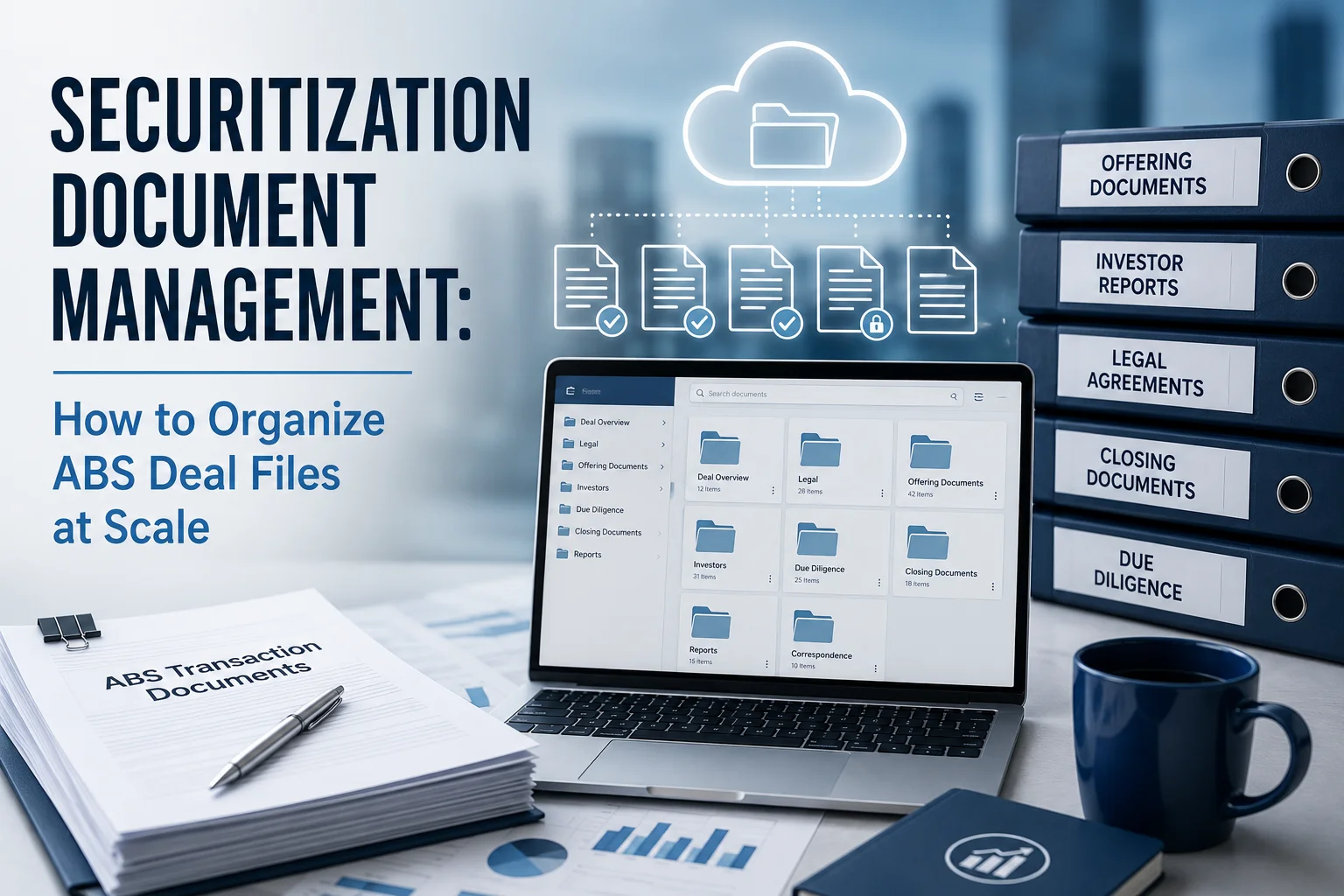
Last Updated on September 8, 2026
Securitization document management is the practice of organizing, indexing, controlling, and retaining the large volume of pool-level and loan-level documents involved in an asset-backed securities transaction.
Done well, it lets many parties review the same materials in parallel; done poorly, it slows the deal, creates security gaps, and complicates disclosure. Because a single pool can hold tens of thousands of asset files, securitization document management is a scale problem first and a process problem second.
Key takeaways
- Securitization generates two layers of documentation, pool-level summaries and loan-level/asset-level data, that must stay linked and searchable.
- Auto-loan and lease pools commonly run from 20,000 to 100,000 assets, so manual file handling does not scale.
- A clear document taxonomy, automated indexing, OCR search, and version control are the core capabilities.
- Asset-level data for registered ABS is filed in a machine-readable format (Form ABS-EE), so data integrity and structure matter.
- Reusable templates turn recurring issuance into a fast, consistent process.
What is Securitization Document Management?
Securitization document management is the discipline of capturing, organizing, securing, and retaining every document in an asset-backed securities transaction so that issuers, investors, rating agencies, and reviewers can find and use the right materials at the right time.
It spans the offering documents, transaction agreements, servicing records, and the asset data that describes the underlying pool.
It differs from ordinary corporate document management because securitization documents are hierarchical and high-volume: a deal is not a folder of contracts but a structured set of pool-level summaries sitting above loan-level records for each underlying asset.
Managing that structure, and keeping it accurate, permissioned, and searchable, is the core challenge.
Why is Securitization Document Management so Demanding?
Securitization document management is demanding because of the sheer scale and granularity of the data. Auto loan and lease ABS pools are typically collateralized by 20,000 to 100,000 individual loans or leases, each carrying its own underwriting records.
Multiply that by the multiple parties reviewing simultaneously, investors, hired and non-hired rating agencies, trustees, servicers, and third-party reviewers, and ad hoc file sharing breaks down quickly.
Three pressures compound the volume. First, regulatory expectations: investors increasingly diligence assets at the loan level rather than relying on pool-level averages, so the granular files have to be both present and navigable.
Second, retention and auditability: deals require a complete, exportable record of what was shared, with whom, and when. Third, repeatability: frequent issuers run the same process again and again, so disorganized one-off handling wastes time on every deal.
How Should You Structure a Securitization Document Repository?
A securitization document repository should be structured as a clear hierarchy that mirrors the deal, offering documents at the top, transaction agreements and legal materials in defined sections, and pool and asset data organized so reviewers can move from summary to detail.
Consistent naming and indexing let many parties navigate the same structure without confusion. The table below shows a typical top-level taxonomy.
| Section | Contents |
| Offering | Prospectus / offering memorandum, term sheets, marketing materials |
| Transaction documents | Pooling and servicing agreement, indenture, trust and SPV documents |
| Asset data | Pool-level statistics, loan-level / asset-level data files |
| Servicing & performance | Servicing reports, collateral performance, surveillance data |
| Legal & credit | Legal opinions, representations and warranties, rating-agency materials |
| Compliance & disclosure | Disclosure records, third-party due-diligence findings, audit logs |
Plan the structure and permissions before uploading, label documents consistently, and use index numbering so files stay findable as volume grows.
How do you Manage Loan-Level and Asset-Level Data Files?
Loan-level and asset-level data files are managed by ingesting them in bulk, validating their structure, and keeping them version-controlled and tightly permissioned, because this is the most granular and sensitive layer of a securitization.
For registered ABS, asset-level data is disclosed in a standardized, machine-readable form; issuers file Form ABS-EE on EDGAR using the data points specified in Schedule AL of Regulation AB, so the underlying data must be clean, structured, and consistent.
Practically, this means the platform should accept large data files and loan tapes without size limits, preserve their integrity through controlled versioning, and restrict access to the borrower-level detail to the parties entitled to see it. Errors or inconsistencies in this layer are costly, so validation and a clear audit trail matter.
How do Indexing, OCR, and Search Work at Scale?
Indexing, OCR, and search are what make tens of thousands of files usable rather than just stored. Automated indexing assigns and orders documents as they are uploaded, so the repository becomes navigable immediately instead of after manual sorting.
Optical character recognition (OCR) reads the text inside documents, including scanned files, so reviewers can search across the entire dataset and locate specific records in seconds.
At securitization scale, this combination is the difference between a reviewer finding a single loan file quickly and losing hours to manual navigation. Bulk utilities, uploading, moving, and mapping content to folder locations in a single operation, extend the same efficiency to the people preparing the room.
How do Version Control and Audit Trails Protect Data Integrity?
Version control and audit trails protect data integrity by ensuring everyone works from the current document and by recording every action taken in the repository. Version control prevents the confusion and risk of multiple conflicting copies, while a complete audit trail logs who viewed, downloaded, or modified each file and when.
In securitization, this record serves two purposes: it supports disclosure and dispute resolution by proving exactly what was shared and accessed, and it gives deal teams real-time insight into reviewer engagement. An exportable activity log should be treated as a core requirement, not an add-on.
How do Reusable Templates Help Recurring Issuers?
Reusable templates help recurring issuers by turning repeated setup work into a one-step process. Frequent issuers, those returning to market through shelf programs or regular issuance, run substantially the same document structure each time. A saved folder template and one-click content mapping let a team stand up a new, consistently organized room in a fraction of the time, reducing setup errors and accelerating time to market.
For active desks, this consistency compounds: every deal starts from a proven structure rather than a blank repository.
Securitization Document Management vs. Generic File Management
Securitization document management differs from generic file management in scale, structure, regulatory rigor, and auditability. Generic file storage is built to hold documents; securitization document management is built to keep a high-volume, hierarchical, regulated dataset accurate, permissioned, and reviewable by many parties at once. The comparison below summarizes the gap.
| Capability | Generic file storage | Securitization document management |
| Volume | Hundreds–thousands of files | Tens of thousands of asset files per pool |
| Structure | Flat folders | Pool-level over loan-level hierarchy |
| Search | Filename search | OCR full-text search across the dataset |
| Permissions | Folder-level sharing | Document-level, role-based access |
| Audit | Basic activity history | Complete, exportable audit trail |
| Disclosure support | None | Reg AB II / 17g-5 disclosure workflows |
Securitization Document Management Best Practices
Apply these practices to keep a securitization repository fast, accurate, and audit-ready:
- Plan structure and permissions first: define the taxonomy and access roles before uploading anything.
- Standardize naming and indexing: consistent labels and index numbering keep files findable at volume.
- Ingest in bulk, then validate: load large datasets quickly, then check loan-level data for integrity.
- Use OCR search: make every document, including scans, full-text searchable.
- Enforce document-level access: scope each party to exactly what they need.
- Keep a complete audit trail: log and export all activity for disclosure and dispute support.
- Templatize for repeat deals: save proven structures so each new issuance starts fast.
Frequently Asked Questions
What is securitization document management?
Securitization document management is the practice of organizing, indexing, securing, and retaining the pool-level and loan-level documents in an asset-backed securities transaction, so issuers, investors, and rating agencies can review the right materials with controlled access and a full audit trail.
How many documents are in a typical securitization?
It varies by asset class, but securitizations are document-heavy: auto loan and lease ABS pools commonly hold 20,000 to 100,000 individual assets, each with its own files, so a single deal can involve very large datasets that require automated indexing and search.
What is the difference between pool-level and loan-level documents?
Pool-level documents summarize the whole asset pool with aggregate statistics, while loan-level (asset-level) documents provide the detailed records for each individual asset. Investors increasingly review loan-level data to assess risk that pool-level averages can obscure.
How is asset-level data disclosed for registered ABS?
For registered ABS, issuers disclose standardized asset-level data by filing Form ABS-EE on EDGAR in a machine-readable XML format, following the data points in Schedule AL of Regulation AB. This makes clean, well-structured underlying data essential.
Can I reuse a document structure across multiple deals?
Yes. Platforms built for securitization let frequent issuers save folder templates and map content into them in one step, so each new deal starts from a proven, consistent structure instead of being built from scratch.

Matthew Small is the Vice President of Strategic Sales and Alliances at SmartRoom, where he builds partnerships and leads strategic efforts to deliver cutting-edge virtual data room solutions for dealmakers. With a strong background in enterprise sales and channel development, Matthew is passionate about unlocking new growth opportunities and helping clients navigate complex transactions with greater speed, security, and confidence.